Independent Creative Exploration// DARK MATTER GRID / INDEPENDENT CASE STUDY P31THE
LE LABO × MUSEUM CONSERVATION
SPECULATIVE COLLABORATIONENTER THE ARCHIVE ↓
PERSONAL DESIGN EXPLORATION / NOT AFFILIATED OR ENDORSED
THE
PROVENANCE
COLLECTION.
LE LABO × MUSEUM CONSERVATIONSPECULATIVE COLLABORATIONENTER THE ARCHIVE ↓
OBJECT / SCENT / SCIENCEPRESERVED BY TIME.
RECREATED BY CHEMISTRY.
RECREATED BY CHEMISTRY.
THE OPPORTUNITYFRAGRANCE AS CULTURAL EVIDENCE
THE QUESTIONWHAT IF
WHAT IF
HISTORY
COULD BE WORN?
I wanted the museum research to change the fragrance object itself. That meant finding a balance between a wearable scent and the uncertainty in an archive. A vessel can tell you about its material and context without revealing an exact formula. The design needed to keep that limit visible.
THE IDEAMaterial evidence guides modern perfumery. The collection directs measurable support back to the conservation science behind it.
THE COLLECTION IDEATHE RESEARCH SHAPES THE OBJECT
TWO FORMULAS, ONE RITUAL
A modern extrait carries the idea every day. A separate archival accord lets the wearer deepen it one measured drop at a time.
CONSERVATION IS BUILT IN
Every edition publishes the exact amount directed to its host institution’s conservation or scientific-research program.
RECREATE, DO NOT DEPLETE
Green chemistry and fermentation recreate selected aroma molecules without increasing pressure on slow-growing or vulnerable botanical sources.
PROPOSED FIRST EDITION
Begin with one object at the bench.
The traveling archive can begin at a single staffed sampling bench. I would use the duck-shaped vessel already referenced in the case to explain the method. Its museum record and the perfumer’s interpretation need their own readable places.
- THE FIRST OFFER
- One proposed source-object edition. A perfumer develops the wearable scent and companion accord, with the museum reviewing the source text. The first display uses reproduction imagery and a label, without moving the original artifact.
- HOW YOU TAKE PART
- The object-led poster leads to the bench. Read the source card, try the wearable scent and compare the companion accord on separate blotters. Leave with a sample and the same record used at the table.
- WHAT I WOULD DELIVER
- One complete label family and its sample card, with a short monograph and a counter display. The vessel illustration gives the packaging its form. A source note distinguishes known evidence from a contemporary scent brief.
- BEFORE IT GROWS
- Can visitors explain which details came from the archive? Test legibility and the sampling sequence before adding editions. Publish a specific conservation contribution only after the recipient and amount are agreed.
Where it could go next
The full packaging family and all pop-up locations remain below. The traveling conservation room is a later edition. Further objects enter after the first research-and-sampling method works with the participating specialists.
THE BRAND DIALOGUEWORKSHOP CRAFT × PUBLIC CULTURE

MADE AT THE BENCH.
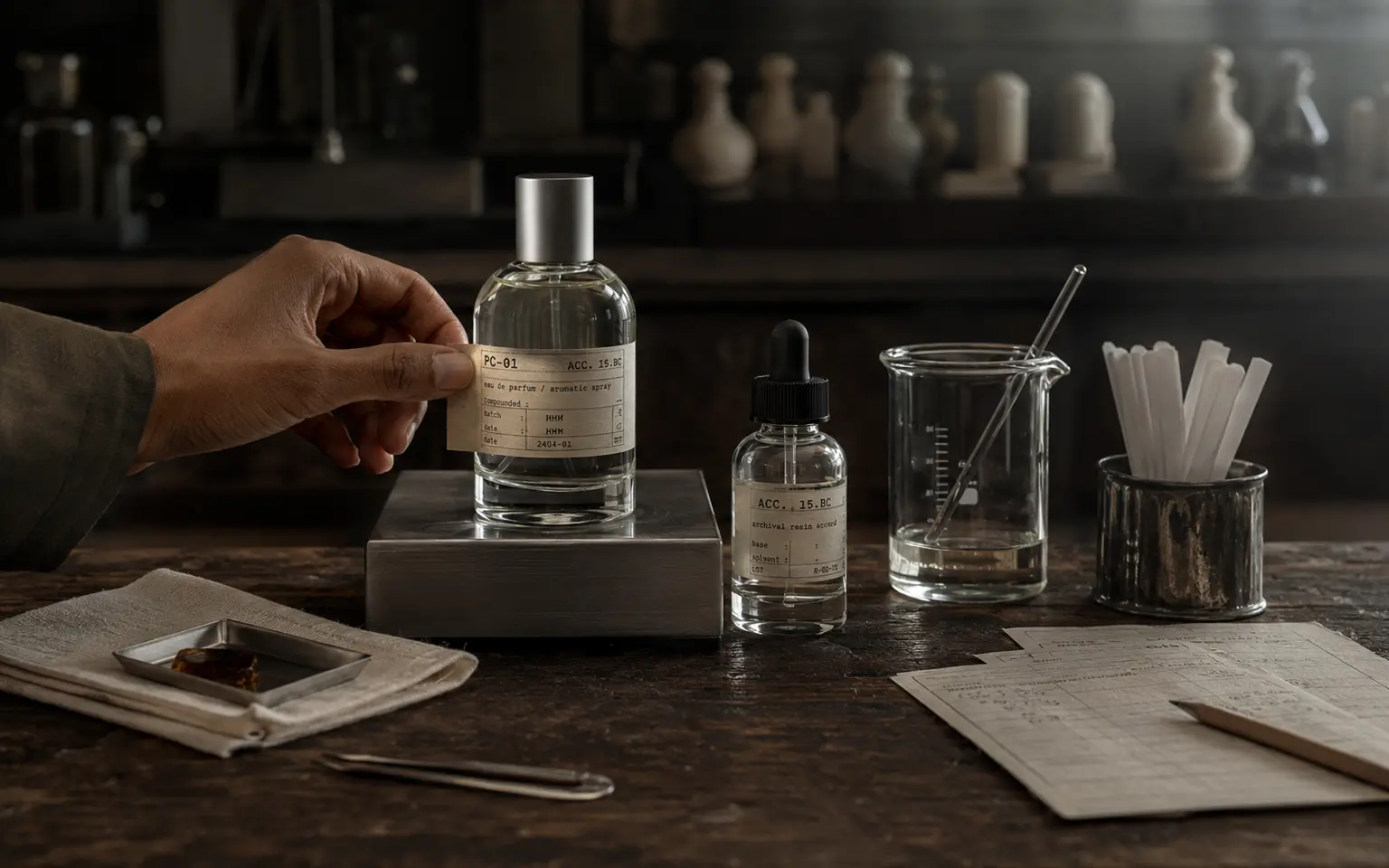
Keep the clear bottles and typewriter labels close to the workbench. Brushed metal and worn wood give the hand-preparation photographs a setting. The refill is another part of that working routine.
MADE FOR THE WORLD.
Large serif headlines introduce the campaign. Printer’s rules divide the supporting information, with a shared layout carrying the work across public placements.
PROVEN BY THE RECORD.
Object labels and visible research methods give the museum a place in the design. Archival paper sits beside stainless steel, with space to read the record.
THE PRODUCT SYSTEMSTUDY 01 / MODERN EXTRAIT + ARCHIVAL ACCORD
THE WEARABILITY FIXONE SCENT.
ONE SCENT.
FOUR DEPTHS.
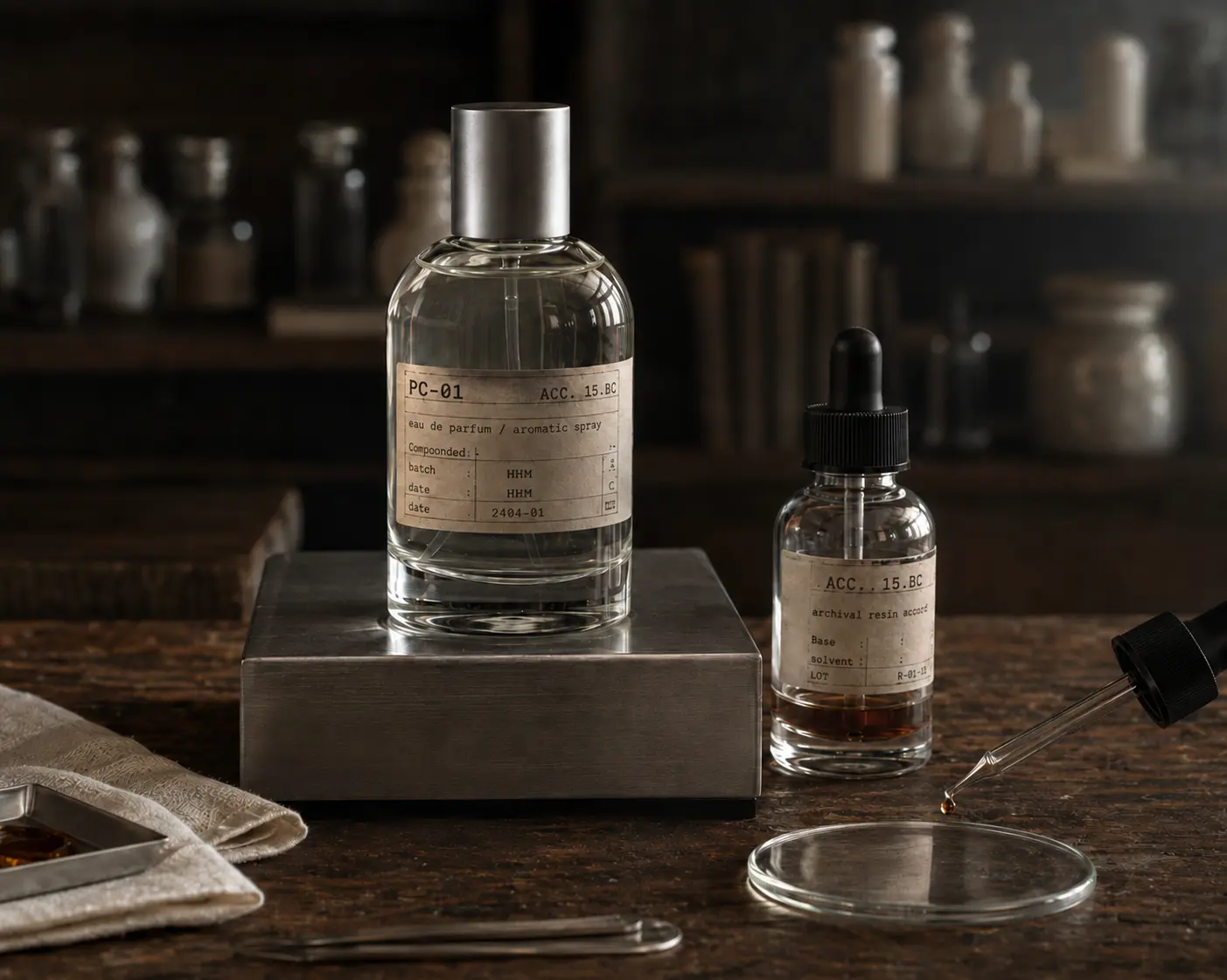
The proposed hero bottle holds a wearable modern extrait. Its companion dropper would hold a contemporary accord inspired by historical resin profiles. A perfumer would develop both formulas, with safety testing before use. The archive supplies the research for a modern interpretation.
FORMULA 01TEXTURED / EVENING
BUILD YOUR RITUALTRACE
1 DROPTEXTURED / EVENING
Myrrh resin / smoked cedar / mineral amber
CONCEPT ONLY / FINAL FORMULATION REQUIRES PERFUMER REVIEW, WITH TOXICOLOGY AND REGULATORY ASSESSMENTMOLECULAR RECONSTRUCTIONSTART WITH THE EVIDENCE
THE SOURCING FIXREBUILD
REBUILD
THE PROFILE.
PROTECT THE SOURCE.
Use published research, residue analysis, chromatography, and historical records to identify plausible material families.
Translate evidence into a contemporary accord. Unknowns stay visible instead of being disguised as certainty.
Green chemistry and fermentation build the aromatic profile alongside responsibly sourced naturals. Rare ancient-strain materials are not harvested.
Each monograph distinguishes evidence from perfumer interpretation and states modern safety requirements.
ARTIFACT STUDY 001THE MET / OBJECT 27.9.1 / PROPOSED CHAPTER
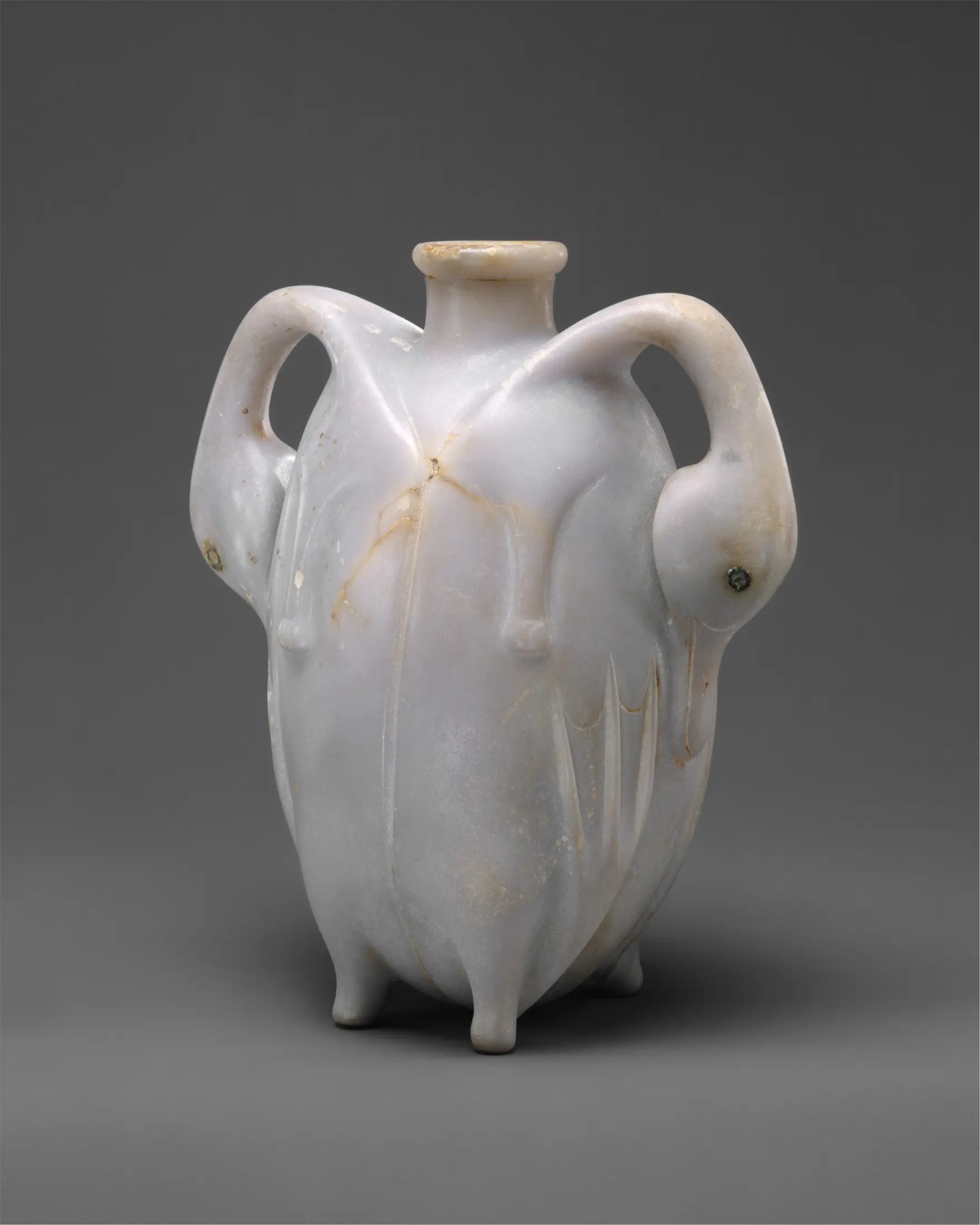
THE SOURCE OBJECT
THE VESSEL BECOMES THE DESIGN SYSTEM.
The Met identifies this anhydrite flask as a perfume or cosmetic vessel from Egypt’s late Second Intermediate Period. Its paired form, mineral blue-gray surface, copper eye inlays, catalog record, and uncertain ritual context become the first packaging chapter.
VIEW THE MET OBJECT RECORD ↗THE COLLECTOR’S EDITIONSTUDY 01 / FORM AFTER OBJECT 27.9.1
THE SOURCE,
IN YOUR HANDS.
I wanted you to recognize the source before reading the label. For the collector’s edition, I carried the paired-duck form into a contemporary porcelain shell, with copper eye details and a removable source tag. The regular edition keeps the familiar clear bottle.
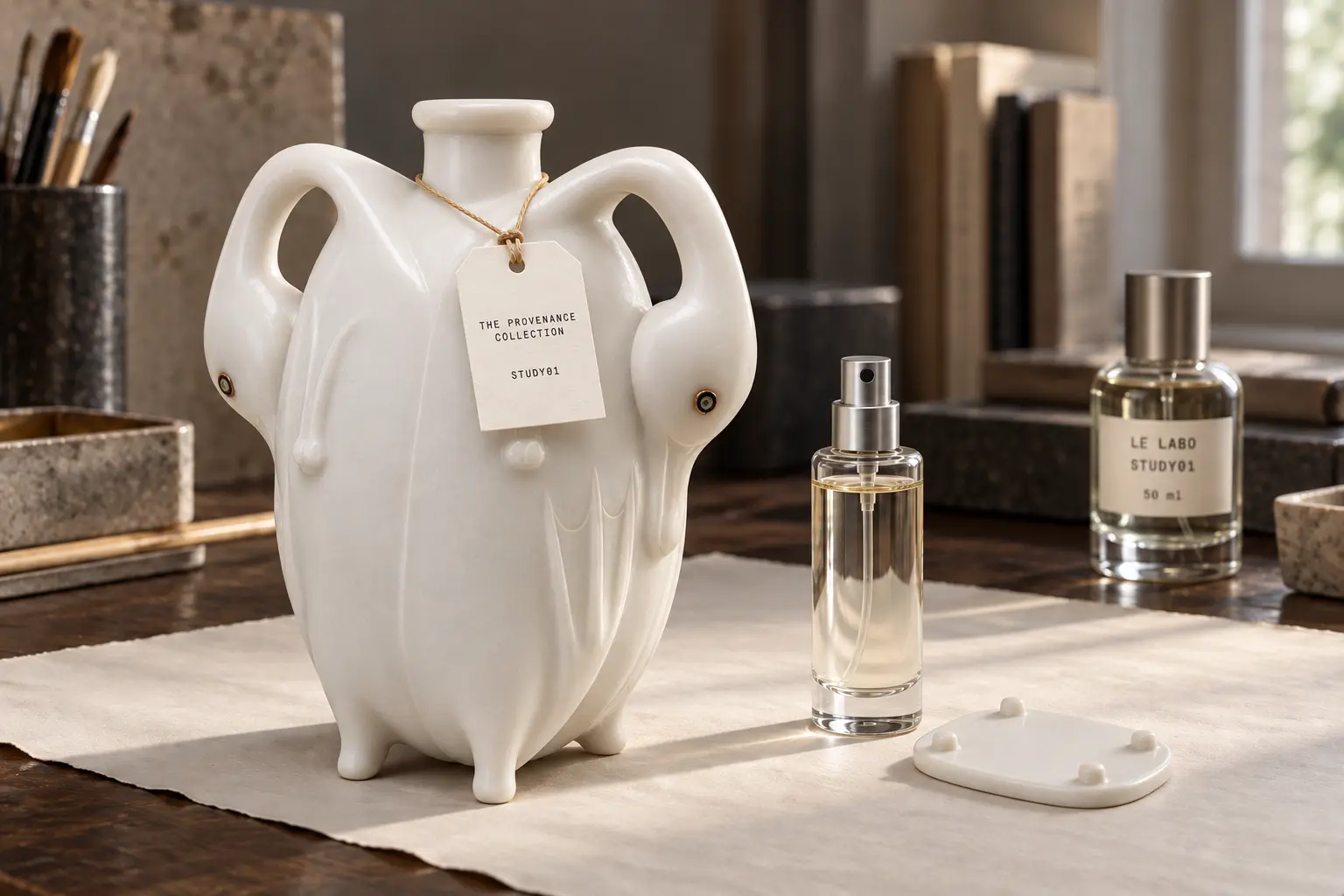
A VESSEL YOU KEEP.
The joined bodies and arched necks follow The Met’s object 27.9.1, dated ca. 1580–1550 BCE. Pale mineral glaze interprets the original anhydrite surface. The tag separates the museum object number from the proposed edition code, STUDY 01.
A BOTTLE INSIDE THE OBJECT.
The design proposes a 50 ml glass insert reached through a removable underside panel. The mockup shows a spare beside the finished vessel. Fit and spray access would need a physical prototype before manufacture.
THE COLLECTOR SYSTEMPACKAGING AS A PORTABLE CATALOG
THE ARTIFACT
SETS THE RULES.
Each edition uses the source object’s silhouette, materials, pigment traces, excavation drawings, and catalog structure. The package draws on the object’s construction and records, giving it a connection beyond the image on its surface.
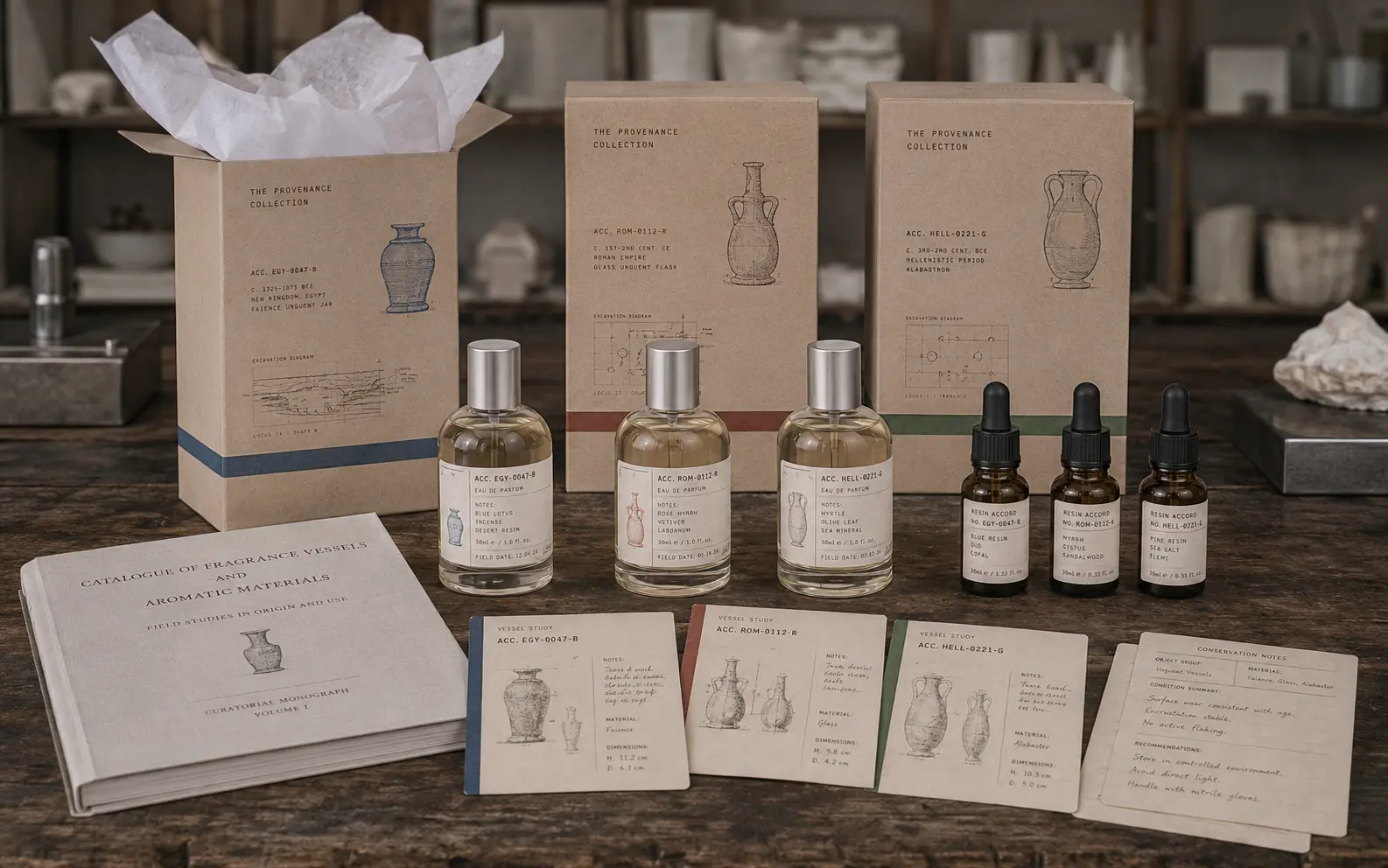
ARTIFACT BOX
Responsibly sourced kraft board lined with acid-free tissue in object-specific colors.
ACCESSION LABEL
A collection code links each bottle to its source and research notes, with the grant contribution disclosed.
CURATORIAL MONOGRAPH
A compact publication distinguishes artifact history, scientific evidence, formulation choices, and open questions.
REFILL RECORD
The bottle stays in circulation. Each refill adds a dated stamp to its digital and physical provenance record.
THE OLFACTORY ARCHIVETRAVELING MUSEUM CONSERVATION ROOMS
THE CITY ACTIVATION
THE LAB MEETS THE CITY.
The pop-up brings working conservation methods into public view. Sealed scent stations stay separate from original artifacts. The local collection guides each edition, with the structure adapted to the site.
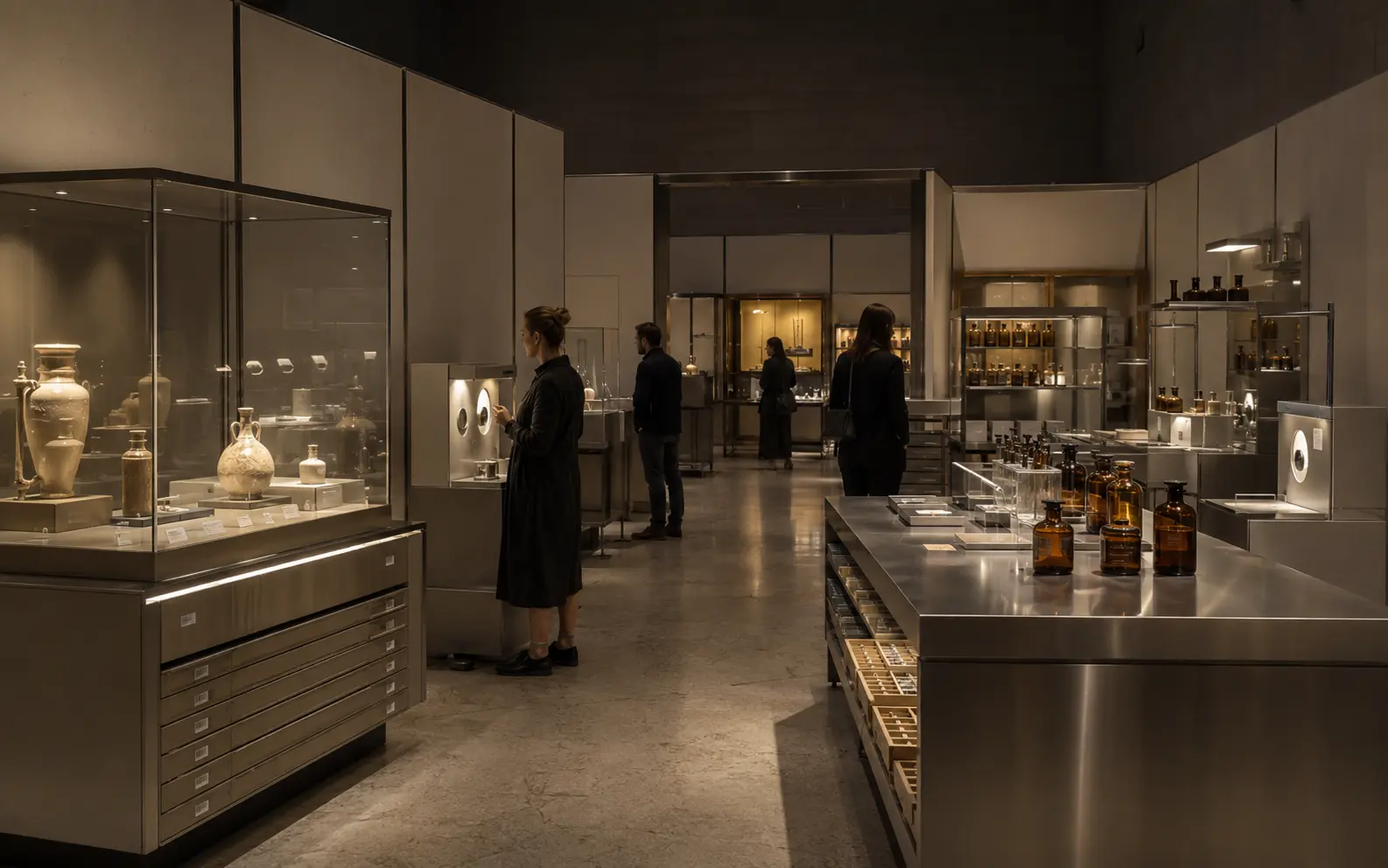
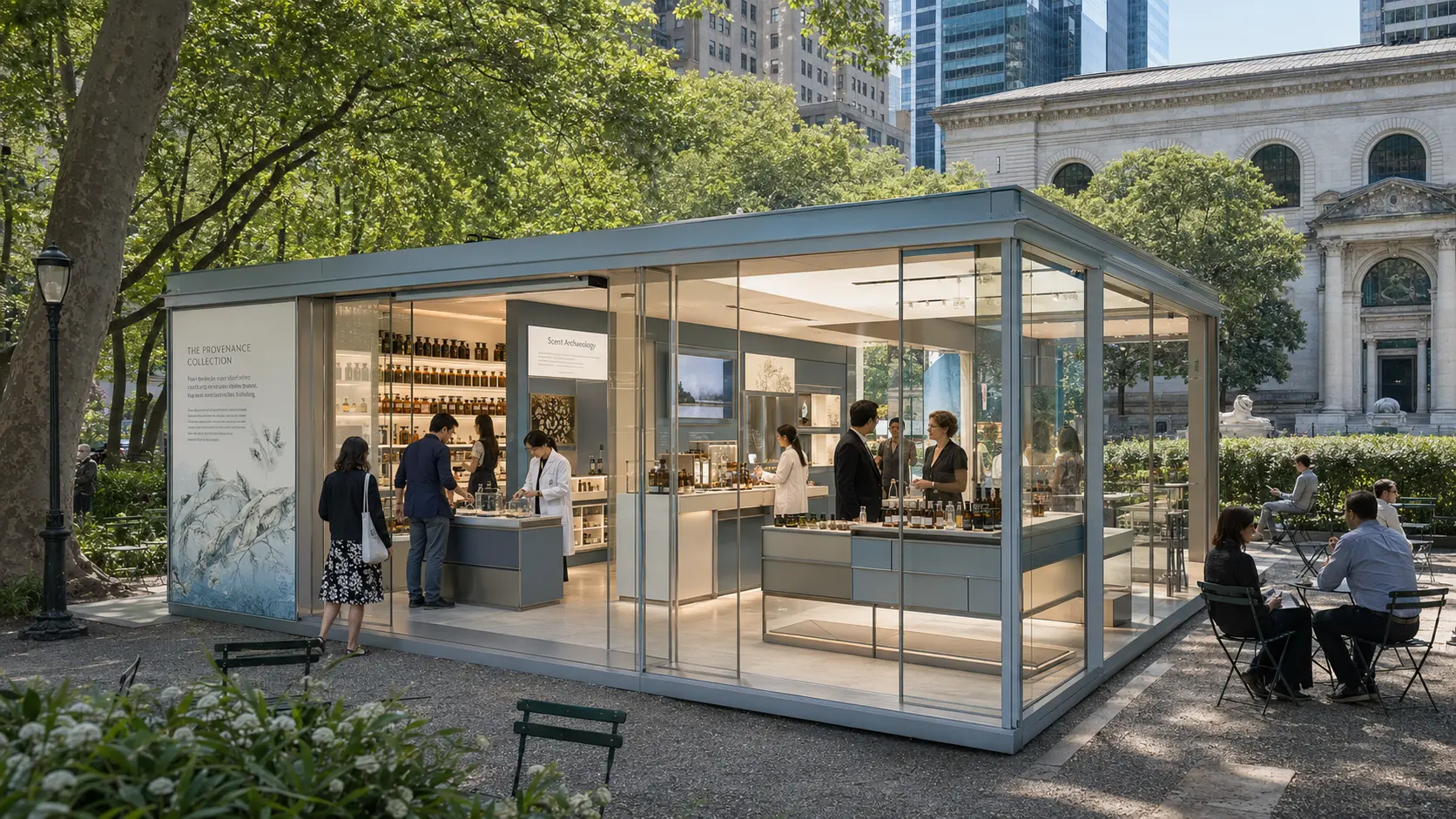
A removable pavilion brings the working archive into Midtown. Visitors can watch formulation at the bench and sample through sealed scent stations. The structure would leave the lawn after the program.
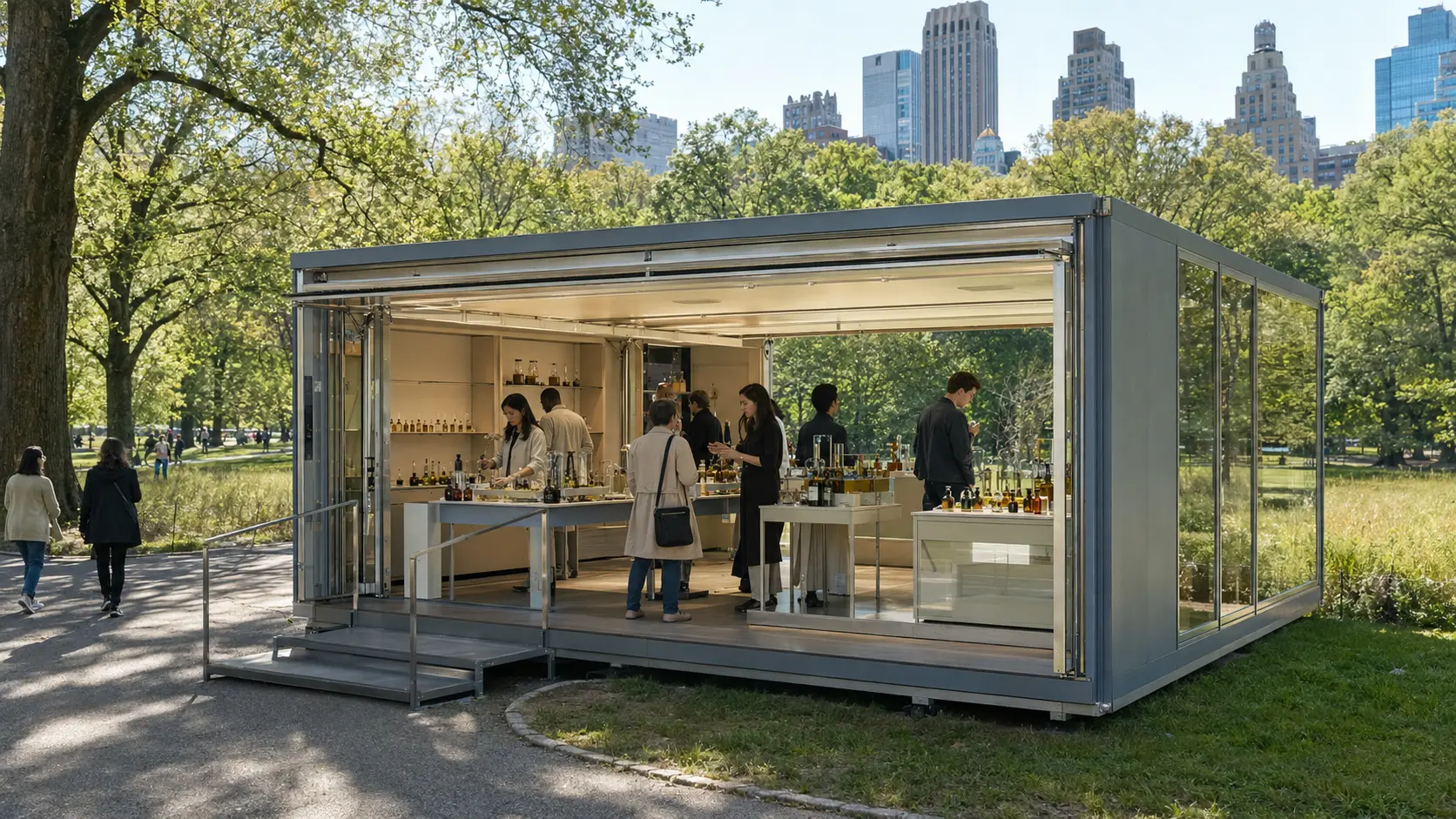
A removable field structure studies historic resins through contemporary green chemistry. The location shapes the research demonstration, with the full structure taken away afterward.
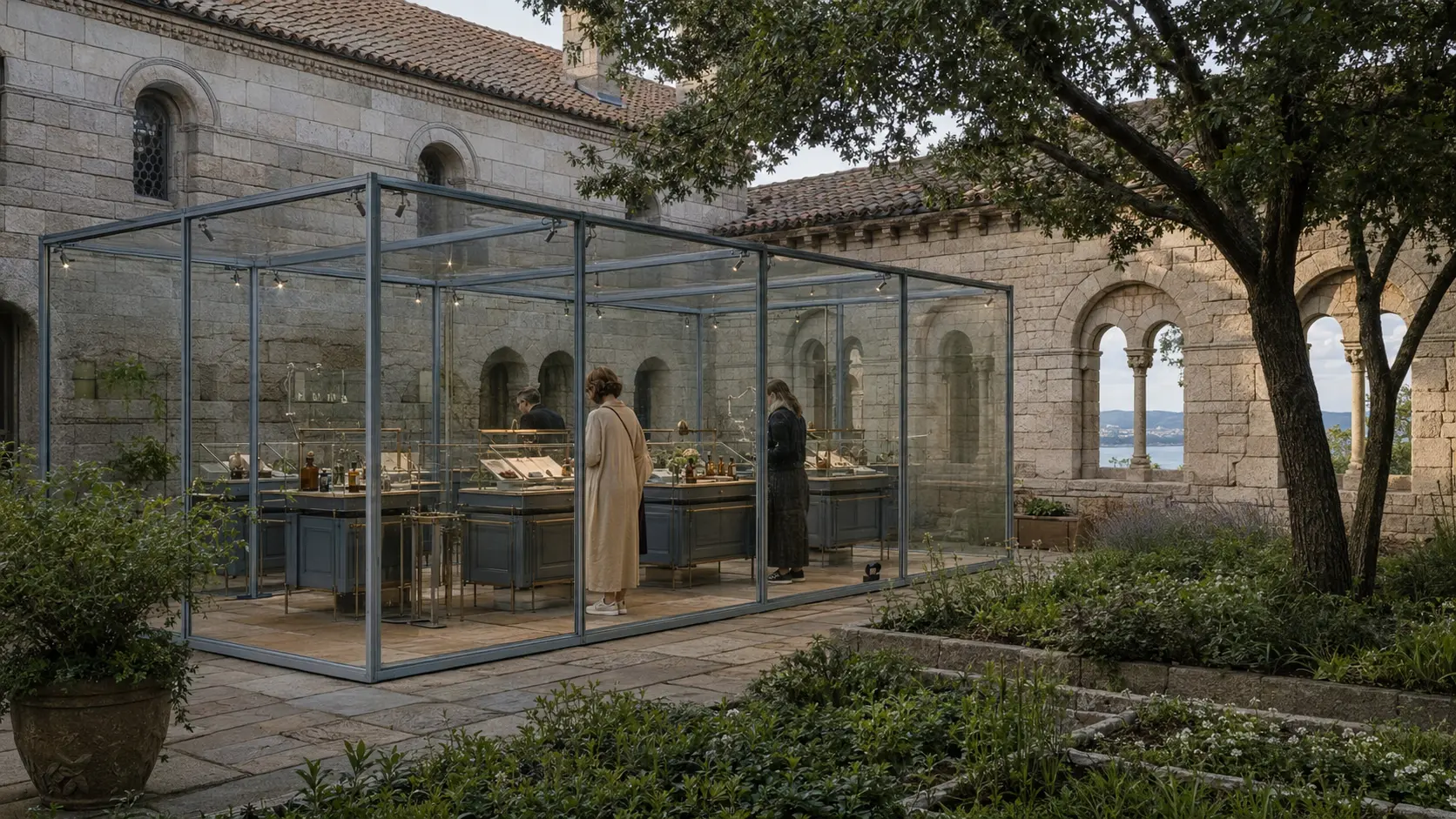
A quiet courtyard installation follows medieval trade routes through garden botanicals and manuscript records. Scent stays outside the galleries and away from original works.
EXPERIENCE TO OWNERSHIPLEARN / LAYER / FUND / REFILL
THE CONSERVATION ROOM
Visitors start with the object record and material evidence, including the limits of what is known.
THE SCENT LIBRARY
Sealed stations separate documented material families from the perfumer’s modern interpretation.
THE LAYERING BENCH
Guests test the wearable extrait at different archival intensities and print a personal formula card.
MUSEUM SHOP + LE LABO
The edition is sold in the host museum shop and pop-up, with selected Le Labo boutiques also carrying it.
THE DISCLOSED GRANT
The exact conservation contribution per set appears on the accession label and campaign ledger.
THE REFILL RECORD
Refills keep the collector bottle in use and add another dated entry to its provenance.
INSTITUTIONAL INTEGRITYTHE CAMPAIGN MUST PROVE ITS OWN CLAIMS
THE NON-NEGOTIABLENO FAKE
NO FAKE
CERTAINTY.
The vessel gives us material evidence and an uncertain context. The scent is a contemporary interpretation. Keep those limits visible on the label and in the demonstration.
- Every historical statement links to a public object or research record.
- Reconstructed notes distinguish evidence from interpretation and identify modern adaptations.
- Every conservation contribution is published as a fixed amount or auditable percentage.
- Every pop-up uses replicas and sealed scent systems, never original objects in a scented environment.
RESEARCH FOUNDATIONPUBLIC SOURCES THAT MAKE THE CONCEPT PLAUSIBLE
THE OBJECT
LEAVES A RECORD.
THE SCENT ADDS A CHAPTER.
The proposal gives each edition a source object and a record you can read. Packaging carries the evidence into the product, while the proposed program connects it to conservation work. I kept uncertainty in the story because the research is more interesting when it is described honestly.
The first test would be a single object-led edition. Can a visitor tell which details come from the record and which belong to the perfumer’s interpretation? I would test that at the label and sampling bench before expanding the collection.
PRESERVED BY TIME. RECREATED BY CHEMISTRY.